Fruit Flies in Your Drain? Here's What's Really Happening (And How to Stop It)
Share
You've covered your fruit bowl. You've taken out the trash. You've wiped down every surface in your kitchen. And yet, fruit flies keep appearing—seemingly out of nowhere.
Here's what most people don't realize: the fruit bowl isn't the problem. Your drain is.
While everyone's focused on covering bananas and cleaning counters, the real breeding ground is hiding in plain sight—right beneath your kitchen sink. Let's talk about what's actually happening in your drain and why understanding this changes everything about how you solve fruit fly problems.
The Science: What's Happening Inside Your Drain
Every time you rinse produce, wash dishes, or use your garbage disposal, microscopic food particles wash down your drain. You can't see them, but they're there—sugars, starches, proteins, and organic matter accumulating in the curved pipe trap beneath your sink.
Over time, these particles don't just sit there. They form something called biofilm—a slimy layer of bacteria, fungi, and organic material that coats the inside of your pipes. This biofilm creates the perfect environment for fruit fly breeding:
• Moisture - Constantly present in drain traps
• Warmth - Room temperature or warmer from hot water use
• Nutrients - Abundant organic matter for larvae to feed on
• Protection - Hidden from light and disturbance
According to entomology research, this combination makes drains one of the most productive breeding sites for fruit flies in the home.
The Math of Why Infestations Explode
Here's where the biology gets alarming. A single female fruit fly can lay up to 500 eggs during her short lifetime. She doesn't lay them all at once—she deposits them in batches on suitable breeding sites, like the biofilm in your drain.
Those eggs hatch in just 24-30 hours. The larvae feed on the organic matter in your drain for about 4-6 days, then pupate and emerge as adults within another 4-6 days. The entire lifecycle from egg to breeding adult takes about a week.
Let's do the math:
• Day 1: One female lays 50 eggs in your drain
• Day 2: Those eggs hatch into larvae
• Day 7: 50 new adult flies emerge (roughly half are female)
• Day 8: Those 25 females each lay 50 eggs = 1,250 new eggs
• Day 14: 1,250 new adults emerge
This is why fruit fly problems seem to explode overnight. You're not dealing with a few flies—you're dealing with exponential population growth happening out of sight in your drains.
Why Traps Don't Solve This Problem
Walk into any home goods store and you'll find shelves of fruit fly traps. Apple cider vinegar solutions, sticky strips, UV zappers—they all promise to eliminate your fruit fly problem.
And technically, they do catch flies. You might trap 10, 20, even 50 adults in a single device.
But here's the fundamental problem: traps only catch adult flies. They do absolutely nothing about the hundreds of eggs hatching in your drain every day.
While you're catching 10 adults in your vinegar trap, 100 more are developing in the biofilm beneath your sink. You're not keeping up with the reproduction rate. You're just managing visible symptoms while the real problem—the breeding site—continues producing new generations.
According to EPA integrated pest management principles, effective pest control requires eliminating breeding sites, not just catching adults. Traps are reactive. Prevention is proactive.
This is why people get stuck in the trap-and-repeat cycle. They catch flies, feel like they're making progress, then wake up to more flies the next morning. It's not that the traps don't work—it's that they're solving the wrong problem.
Signs Your Drain Is the Problem
How do you know if your drain is the primary breeding ground? Look for these telltale signs:
Flies congregating near the sink - If you consistently see fruit flies hovering around your kitchen or bathroom sink, they're likely emerging from the drain below.
Flies appearing even with no fruit out - This is the biggest clue. If you've removed all produce, covered everything, and still have flies, they're breeding somewhere that has nothing to do with fruit. That somewhere is usually your drain.
Flies in the bathroom - There's definitely no fruit in your bathroom. If you're seeing fruit flies near bathroom sinks or showers, it's 100% a drain issue.
The problem returns within days - You clean everything, catch a bunch of flies, and think you've solved it. Then three days later, they're back. This pattern indicates an active breeding site that you haven't addressed—almost always drains.
More flies in the morning - Fruit flies are most active during warmer parts of the day. If you notice more flies in the morning after they've been emerging from drains overnight, that's a strong indicator.
The Two-Part Solution: Breaking the Breeding Cycle
If you want to actually solve a fruit fly problem instead of just managing it indefinitely, you need to understand the difference between catching adults and breaking the breeding cycle.
Catching adults is reactive. You're waiting for flies to appear, then trying to remove them. But for every adult you catch, dozens more are developing in breeding sites.
Breaking the breeding cycle is proactive. You eliminate the environments where eggs are laid and larvae develop, which means no new adults emerge. The flies you see become the last generation, not the beginning of an endless infestation.
An effective solution requires attacking both components:
1. Eliminate the breeding site (your drain) - Break down the biofilm where eggs are laid and larvae feed. No breeding site means no new eggs, no larvae, no new adults.
2. Deter adults from laying more eggs - Create an environment that's inhospitable to fruit flies, so even if adults are present, they can't establish new breeding sites.
This two-pronged approach is what actually solves infestations. You're not just catching flies—you're making your home a place where fruit flies can't reproduce.
How to Treat Your Drain
The key to eliminating drain breeding is breaking down the organic biofilm where fruit flies lay their eggs.
Enzyme-based drain treatments work by digesting the organic matter at a molecular level. Unlike harsh chemical drain cleaners that just push debris further down the pipe, enzymatic solutions actually break down the biofilm coating, eliminating the breeding substrate.
Research shows that essential oils like peppermint and lemon not only deter fruit flies but also help break down organic residues when properly formulated. These natural options are safe for daily use, won't damage your plumbing, and don't introduce harsh chemicals into your home.
During an active infestation: Treat drains daily. You need to consistently break down the biofilm and create an inhospitable environment for eggs and larvae. This means treating kitchen sinks, bathroom sinks, shower drains—any drain with organic buildup.
For maintenance: Once you've eliminated the infestation, weekly drain treatment prevents biofilm from re-accumulating and keeps breeding sites from re-establishing.
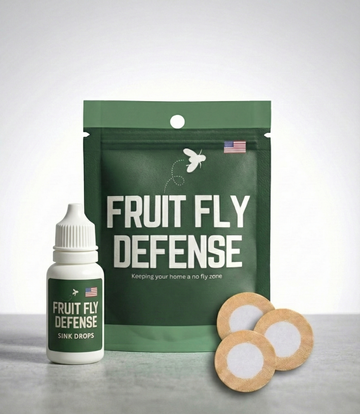
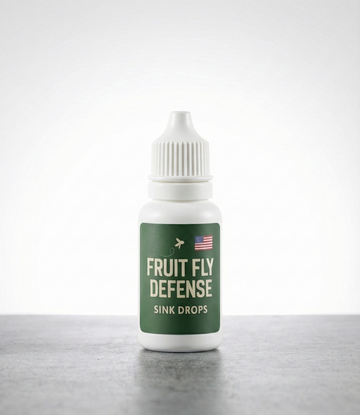
Our Sink Drops were specifically formulated for this purpose—plant-based essential oils that break down drain biofilm while creating a deterrent barrier that prevents fruit flies from breeding. It's the drain treatment component of a complete prevention system.
Prevention Going Forward
Once you've addressed the existing infestation, maintaining a fly-free home requires consistent habits:
Run water after using the disposal - Let water run for 15-20 seconds after grinding food to flush particles through the trap and prevent accumulation.
Don't let food particles sit - Rinse dishes promptly rather than letting them sit in the sink with food residue.
Weekly drain maintenance - Make drain treatment part of your regular cleaning routine, just like taking out the trash or wiping counters.
Use deterrents near fruit and produce - While drains are the primary breeding site, you still want to keep adult flies away from produce and other potential attractants. Surface deterrents create barriers that prevent flies from exploring and laying eggs in other areas.
Address all drains - Don't forget bathroom sinks, shower drains, and utility sinks. Any drain with organic buildup can support breeding.
Monitor for early signs - If you see even a few flies, address it immediately with drain treatment. Don't wait for it to become a full infestation.
A Complete Prevention System
As a biologist, I founded Fruit Fly Defense because I understood that traps were solving the wrong problem. Fruit flies aren't a trapping challenge—they're a breeding site challenge.
That's why we're a deterrent company, not a trap company. Our approach focuses on eliminating breeding sites and creating environments where fruit flies can't thrive, rather than just catching adults after the problem has already developed.
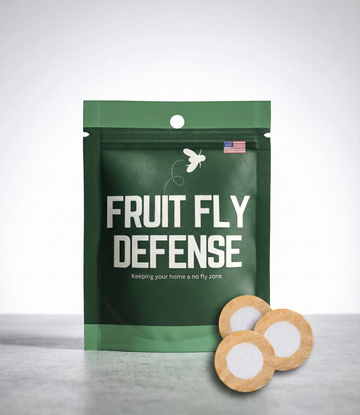
The most effective prevention pairs drain treatment with surface deterrents. Sink Drops eliminate breeding in your drains, while surface deterrents keep flies away from counters, fruit bowls, and other areas where they might explore for food or laying sites.
Together, they create a complete system that breaks the breeding cycle at its source.
Ready to Stop the Cycle?
If you're tired of the trap-and-repeat cycle and ready for a solution that actually addresses the root cause, our Combo Pack includes both drain treatment and surface deterrents—everything you need to eliminate breeding sites and prevent new infestations.
Because you shouldn't have to live with fruit flies. And once you understand what's really happening in your drain, you don't have to.