How to Get Rid of Fruit Flies in a Restaurant
Share
A fruit fly near a customer's food isn't just annoying — it's a potential health code violation, a one-star review waiting to happen, and a sign that something in your operation needs to change.
The challenge in a restaurant is scale. You have more drains, more produce, more bar residue, more garbage volume, and more flies than a home kitchen ever will. What works at home often isn't enough for commercial use.
Here's the approach that actually works in professional food service — including the one used by Chick-fil-A and Dave & Buster's.
Why are fruit flies such a problem in restaurants?
Fruit flies are a persistent problem in restaurants because commercial kitchens provide ideal breeding conditions at a scale that's difficult to control — high-volume drains with constant organic buildup, produce storage areas, bar drains with fermented residue, and frequent garbage cycling. According to the CDC, fruit flies can transfer bacteria from contaminated surfaces to food and food prep areas, making their presence a food safety concern, not just an aesthetic one. Most restaurant fruit fly problems stem from drains, not from produce or visible food sources.
What causes fruit flies in a bar or restaurant?
Restaurant and bar fruit fly infestations are almost always caused by organic buildup in drains — specifically the floor drains, bar drains, and sink drains where fermented residue accumulates. Bar drains are particularly problematic because beer, wine, and juice residue create an optimal fruit fly breeding environment. A single floor drain in a busy bar can sustain a fruit fly infestation indefinitely if not treated at the source. Secondary causes include produce storage areas, recycling stations with bottle and can residue, and mop buckets that retain organic material.
Is having fruit flies in a restaurant a health code violation?
Having fruit flies in a restaurant can constitute a health code violation depending on jurisdiction and inspector assessment. Most health codes classify fruit flies as a "pest" requiring active control measures, and a significant infestation visible to an inspector typically results in a violation. Beyond the regulatory risk, the CDC notes that fruit flies are capable of transferring pathogenic bacteria — including E. coli and Salmonella — from contaminated sources to food contact surfaces. This makes control a food safety issue, not just a compliance issue.
What do commercial pest control companies use for fruit flies in restaurants?
Most commercial pest control companies approach restaurant fruit fly problems with a combination of drain gel treatments, UV traps for adult flies, and sanitation recommendations. The drain gel category is where the most effective products operate — these coat the interior pipe walls and break down organic material where fruit flies breed. Chemical insecticide sprays are generally not used in food service environments due to safety regulations and proximity to food. The standard professional approach targets the breeding site directly rather than the adult fly population.
Can you use natural fruit fly deterrents in a commercial kitchen?
Natural fruit fly deterrents based on essential oils are not only effective in commercial kitchens — they're often preferred because they don't introduce synthetic chemicals into a food service environment. Essential oil-based products are safe for use near food preparation areas and produce storage when properly formulated, and they don't carry the regulatory risk or liability of insecticide-based approaches. Several national restaurant chains have moved to natural deterrent systems specifically because they can be deployed at the counter, in produce areas, and near bar taps without creating food safety concerns.
Fruit Fly Defense products are currently deployed in Chick-fil-A, Dave & Buster's, and LongHorn Steakhouse locations — the same formula used in home applications, scaled for commercial deployment across multiple drain and surface points.
How to set up a restaurant fruit fly prevention system
A commercial fruit fly prevention system needs to address three zones: drains, surfaces, and produce/waste areas.
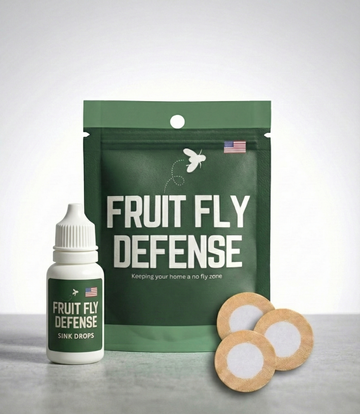
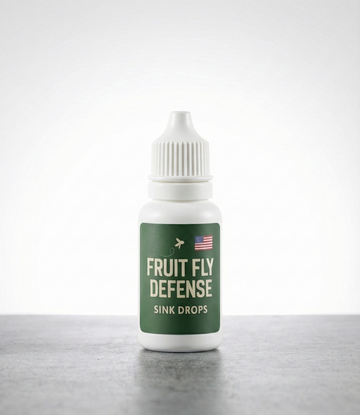
Zone 1 — Drains (highest priority) Every floor drain, bar drain, and sink drain is a potential breeding site. Treat each drain nightly with a natural drain deterrent — Fruit Fly Defense Sink Drops applied directly to the drain after closing creates a hostile environment for eggs and larvae overnight. For high-volume bar drains, apply before and after peak service.
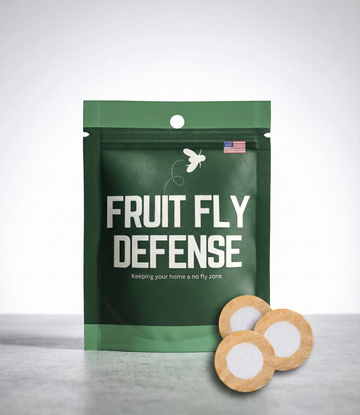
Zone 2 — Surface deterrents Place deterrent discs near draft beer systems, produce storage, and prep areas. The scent barrier created by essential oil discs makes these zones unattractive to adult flies seeking new breeding sites. Fruit Fly Defense Deterrent Discs last 4–6 weeks per disc and are discreet enough to place near customer-facing areas.
Zone 3 — Waste management Ensure recycling containers are rinsed before use, mop buckets are emptied and rinsed after each use, and produce waste is removed daily. No deterrent system fully compensates for a persistent organic waste source nearby.
How much does commercial fruit fly control cost?
Commercial fruit fly control through a pest control service typically costs $150–$500 per visit for a restaurant, with monthly contracts often running $200–$400. Chemical treatment programs can add liability considerations and require safety protocols around food. A deterrent-based approach using Fruit Fly Defense costs significantly less at scale — the Power Up Pack provides 12 deterrent discs for multi-zone coverage, and Sink Drops are used a few drops per drain per night, making a single bottle last weeks across multiple drains.
The standard most restaurants are missing
Most restaurant fruit fly programs treat the symptom — UV traps catching adult flies — without treating the breeding source in the drains. The result is a trap that fills up constantly while new flies keep emerging from below.
The commercial chains that have solved the problem permanently have moved to drain-first prevention. Fix the drain environment, and the fly population above it collapses within one to two weeks.