
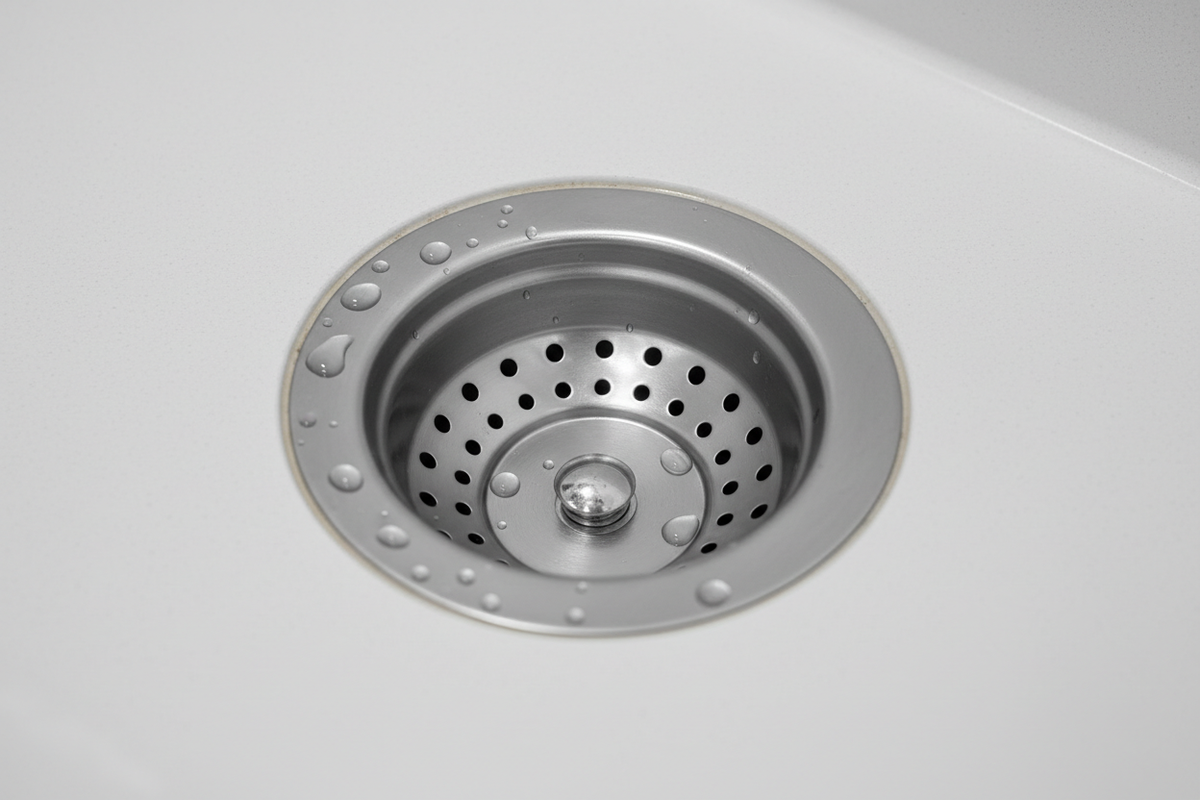
Fruit flies hovering at the sink are usually breeding in the film inside the drain or disposal, not on your fruit. Confirm with a tape test overnight, then scrub the drain with a stiff brush, flush with hot water, and run the disposal clean. Keep that up nightly for two weeks and the generations in the pipe run out.
Why are there fruit flies in my drain?
Every time you rinse a plate or run the disposal, a little food goes down and some of it sticks. Over weeks it builds a slick, dark coating on the pipe wall just below the strainer and inside the trap, the U bend under the sink that always holds water. That coating is biofilm: bacteria, yeast, grease and food particles bound together in a slime. It is wet, it is warm, it is fermenting, and it is never disturbed. To a fruit fly that is a perfect nursery.
University of Kentucky entomologists list drains and garbage disposals among the standard breeding sites for fruit flies, alongside bottles, cans, trash, mops and rags. The life cycle, egg to adult, is about a week in warm conditions, and each female can lay around 500 eggs. So one female that finds your drain in June can be the great grandmother of a swarm by the Fourth of July.
How do I know the flies are coming from the drain?
Do the tape test extension entomologists recommend. Before bed, dry the rim of the drain and press a strip of clear tape across the opening, sticky side down. Do not seal it completely; leave a slot for air so flies still come up. In the morning, peel it off and look at the underside. Fruit flies stuck to the tape mean the drain is producing them. Test each drain separately: kitchen sink, both bowls if you have a double sink, the disposal side, the bathroom sink, the shower. A negative result on the kitchen sink does not clear the bathroom.
Two other tells: flies that are most active at the sink first thing in the morning, and flies in a bathroom where there has never been fruit. A flashlight down the drain will often show the dark film on the walls, though you can have a breeding drain that looks clean from above.
Is it a fruit fly, a drain fly or a fungus gnat?
Three small flies show up around drains and they call for different fixes. A quick identification saves a week of scrubbing the wrong thing.
| Fruit fly | Drain fly | Fungus gnat | |
|---|---|---|---|
| Looks like | Tan to brown body, often red eyes, rounded | Fuzzy, gray, moth like, holds wings flat like a tent | Dark, slender, long legs, like a tiny mosquito |
| Flies how | Quick, erratic, hovers over the sink or fruit | Weak flier, sits on walls and tile near the drain, hops when disturbed | Drifts slowly, runs across soil |
| Hangs out | Sink, fruit bowl, trash, recycling, bar bottles | Shower, tub, floor drains, rarely used sinks | Houseplants, windows near plants |
| Breeds in | Fermenting food film in drains and disposals, overripe produce, bottle dregs | Gelatinous sludge in drain traps and overflow pipes | Damp potting soil |
| Fix | Scrub and flush drains, refrigerate fruit, trash out nightly | Scrub the drain and overflow, flush hot, keep it in use | Let soil dry between waterings, yellow sticky cards |
Drain flies and fruit flies both respond to the same brush and hot water routine, so if you cannot tell them apart, the fix is still the fix. Fungus gnats do not care about your drain at all.
How do I clean a drain that has fruit flies in it?
Texas A&M AgriLife's guidance on indoor flies is blunt: scrub drains with a stiff brush and flush with hot water. Purdue Extension says to clear drains and disposals regularly. Pouring something down a drain is not cleaning it. Scrubbing is. Here is the routine that takes about five minutes a night.
- Pull the strainer or stopper. Wash it in hot soapy water. The underside is usually coated.
- Scrub the throat of the drain. Use a long, stiff drain brush (a bottle brush works) and push it as far down as it goes, turning as you pull it back. You will bring up gray sludge. That sludge is the nursery.
- Scrub the overflow. Bathroom sinks and tubs have an overflow hole near the rim that connects to the drain below the stopper. Film collects there too. Work the brush in from the top.
- Flush with hot water. Run the hot tap for a full minute. Hot tap water is enough; it is the scrubbing that removes the film and the flush that carries it away.
- Dry the sink and the rim. A wet sink at midnight is where eggs get laid.
During an outbreak, do this nightly for two weeks. After that, once a week keeps the film from rebuilding. If a drain is slow, the trap below is holding more sludge than the brush can reach; clearing a slow drain is part of the fix, not a separate chore.
What about the garbage disposal?
The disposal is a drain with a rubber lid that traps food against the underside of itself. Pull the splash guard up (most lift out) and scrub both sides of it in the sink. Scrub the chamber walls with the brush. Then run the disposal with cold water and a tray of ice cubes to knock loose what is packed in the grinding ring, and follow with a hot flush. Run the disposal every day even if you did not put food in it. A disposal that sits idle for a few days with food inside is a drain that has been given a head start.
Can fruit flies come from the dishwasher or the air gap?
Yes, both. The dishwasher filter at the bottom of the tub collects food that sits warm and wet between cycles; pull it, scrub it, and run an empty hot cycle. The air gap, the little chrome cylinder on the back of the sink, has a cap you can lift off. Underneath is a small chamber where dishwasher water passes on the way to the drain, and it collects gunk. Scrub it out and run the dishwasher to flush it. If flies cluster around the air gap cap, that is your answer.
Does bleach get rid of fruit flies in drains?
Extension guidance does not rely on it, and the reason is practical. Bleach poured into a drain runs through in seconds and sits in the trap diluted by whatever water is already there. It does not scrub anything off the pipe wall, and the film is what the larvae live in. People pour bleach every night for a month and see no change, then scrub once with a brush and see the difference in a week. Boiling water has the same limitation; it passes the film rather than removing it, and it is hard on PVC fittings. Save the effort for the brush.
The baking soda and vinegar fizz is more show than scrub. It will not hurt, but remember that vinegar odor attracts fruit flies (Becher and colleagues, 2010), so pouring vinegar in a drain you are trying to make unappealing is not an obviously good idea. A hot water flush after the brush does more.
What should a nightly drain routine look like?
The whole point is consistency. The generation of eggs in your pipe today will be adults in about a week. If you clean once, those adults emerge, lay in the rebuilt film, and you are back where you started. If you clean every night, each generation finds less to lay in than the last. Here is the two minute version once the big scrub is done:
- Dishes washed or loaded, nothing left soaking.
- Strainer rinsed, disposal run with water, drain flushed hot for a minute.
- Quick pass with the brush, three or four strokes.
- Sink and rim wiped dry.
- Trash out, recycling rinsed, ripe fruit in the fridge, sponge wrung out and standing up to dry.
Tape a drain again at the end of week two. A clean strip in the morning is the finish line.
What to do tonight
- Tape over every drain in the house, kitchen and bath, with a gap for air.
- Pull the kitchen strainer and the disposal splash guard and wash both.
- Scrub the drain throat and the disposal chamber with a stiff brush until the brush comes up clean.
- Run the disposal with ice and cold water, then flush hot for a minute.
- Pull and scrub the dishwasher filter, lift the air gap cap and clean it.
- Wipe the sink dry, take out the trash, refrigerate ripe fruit.
- Check the tape in the morning and repeat the scrub nightly on whichever drain tested positive.
Where Fruit Fly Defense fits
Sink Drops are the piece we make for the drain. They are peppermint oil, cedarwood oil, white vinegar and castile soap, and the routine is three to five drops in each kitchen drain at night after the scrub and the hot flush. They go in the drain where fruit flies can breed, as part of a nightly drain routine alongside the brush and hot water. We do not claim the drops treat or clear a drain; the brush does that work, and the drops are the last step of the routine.
Deterrent Discs cover the other side of the sink: natural wood discs hand soaked in 75 percent organic peppermint oil and 25 percent clove oil, one stuck under the sink lip or near the trash with a velcro dot, replaced when the scent fades. Lab studies on peppermint oil, menthol and eugenol found they repelled fruit flies and reduced egg laying; those studies tested the ingredients, not our products. The Combo Pack has both, shipping in the US is free, and there is a 30 day money back guarantee.

Discs for the counter plus Sink Drops that go in the drain, where fruit flies can breed and a trap never reaches. Free US shipping over $35 and a 30-day money-back guarantee.

Biologist (Miami University) and founder of Fruit Fly Defense in Greenville, SC. Every guide is written from the published research and our own kitchen. Questions? donny@fruitflydefense.com
Keep reading

Fruit fly, drain fly or fungus gnat? How to tell which one you have
A side-by-side table, the overnight tape test, and the right fix for each: fruit flies, drain flies and fungus gnats need different...

How to get rid of fruit flies (and keep them from coming back)
Find the drain, trash or fruit that is breeding them, clean it, and keep a two week routine. Where traps and deterrents...

Natural fruit fly repellent: does it actually work?
Peppermint, menthol and clove have lab evidence against fruit flies. Basil, lavender and citrus peels do not. What to expect from a...